





















A Family Tree Full of Colors and Flavors: The Fascinating World of Domestic Plum (Prunus domestica) Subspecies
A Family Tree Full of Colors and Flavors: The Fascinating World of Domestic Plum (Prunus domestica) Subspecies
If we had to look for a master of transformation in the plant kingdom, the domestic plum (Prunus domestica L.) would undoubtedly stand on the winner's podium. This hexaploid species, which originated millennia ago likely by crossing the diploid cherry plum (myrobalan) and the tetraploid blackthorn (sloe) in the Caucasus region, is a textbook example of genetic polymorphism.
It is precisely this complex genetic makeup that has caused the domestic plum to be more than just one uniform tree. Over centuries of natural evolution and targeted human breeding, it has splintered into an incredible number of forms, shapes, colors, and flavors. While agronomists often divide plums into pomological groups based on economic use, botanists have created a detailed system of subspecies (subspecies - ssp.) that brings order to this fruity chaos.
“Modern botanical systematics most often classifies forms such as greengages or mirabelles as subspecies within one large, variable species, Prunus domestica. This approach best reflects their common genetic foundation and their ability to crossbreed with each other.”
1. True Plums / Prunes (Prunus domestica ssp. domestica)
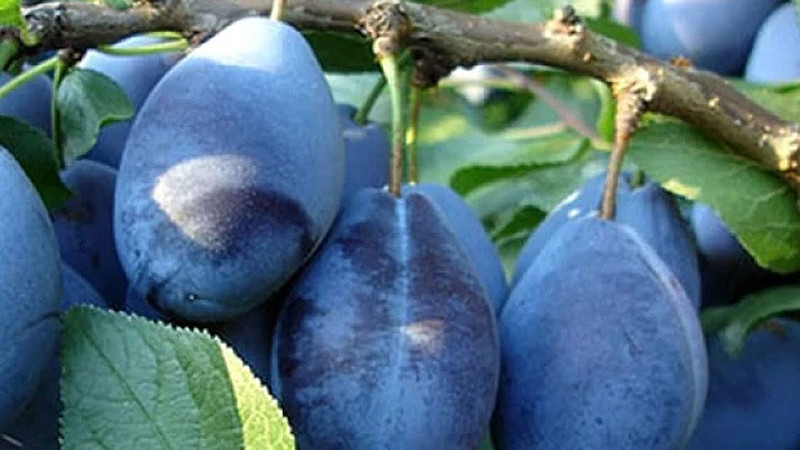
This is the nominate and economically most significant subspecies, which most of us imagine under the term "classic plum." In literature, this group is often referred to by the English term "Prunes."
- Morphology: Fruits are medium to large (25 – 65 g), typically elongated-oval in shape. The skin is dark blue, violet to blue-black, covered with a heavy waxy bloom. The flesh is yellow, golden-yellow to orange.
- Traits: They are characterized by firm flesh, a freestone pit, and a high content of sugars and sorbitol.
- Use: Thanks to their high dry matter content, they are ideal for drying without fermenting during the process. They are also the basis for making traditional jams and distillates (plum brandy/slivovitz).
2. Greengages (Prunus domestica ssp. italica)
Greengages are the aristocracy among plums. They received their international name "Reine Claude" in honor of the French Queen Claude, wife of Francis I, who exceptionally enjoyed these fruits.
Queens of Juiciness
The fruits are almost perfectly spherical. The skin typically has a green, yellow-green to golden color, sometimes with a faint red blush on the sun-exposed side. The flesh is extremely sweet, soft, very juicy, and aromatic. The stone usually separates well. Because of their delicate texture, they are primarily intended for fresh consumption or premium compotes (they are not suitable for drying).
3. Mirabelles (Prunus domestica ssp. syriaca)
Mirabelles are often confused by laypeople with the cherry plum (myrobalan), but botanically, they are a noble subspecies of the domestic plum with unmistakable aromas and polyphenols.
- Morphology: The fruits are very small (often only 2 – 3 cm), perfectly round. The skin is bright yellow to golden-yellow, often dotted with tiny red speckles (freckles).
- Traits: The flesh is yellow, firm, but extremely sweet and highly aromatic with a freestone pit.
- Use: They are highly valued in French gastronomy (especially in the Lorraine region) for making jams, tarts, and the famous distillate Eau-de-vie de Mirabelle.
4. Damsons / Bullaces (Prunus domestica ssp. insititia)
This subspecies represents an older, more primitive branch of plums that is closer to its wild ancestors.
Masters of Pectin
The trees are smaller, often shrub-like, and their branches may be slightly thorny (a legacy of the sloe). The fruits are smaller, spherical, usually dark blue. The flesh clings tightly to the stone (clingstone) and the taste is typically more astringent (tart) and acidic. Thanks to an extremely high pectin content, they are unsurpassed for making jellies and jams. In Europe, they are also often used as a valuable generative rootstock for other plum varieties.
Lesser-Known Transitional Forms and Subspecies
| Subspecies | Common Name | Characteristics and Use |
|---|---|---|
| ssp. intermedia | Semi-plums | A transitional form between true plums and damsons. Fruits are oval, blue. Flesh is sweetish, the stone separates only partially. Universal for the backyard. |
| ssp. pomariorum | Spilling | Similar in shape to greengages (round), but the color is dark blue and the flesh is yellow-green with a free stone. Many Central European local varieties belong here. |
| ssp. prisca | Primitive plums | From Latin "ancient". Tiny elliptical fruits, less juicy, often tart with an inseparable stone. Valuable genetic material (disease resistance), excellent for distillates (adding spiciness). |
Conclusion
The species Prunus domestica is a huge family whose members—subspecies—have adapted to different climatic conditions and human culinary needs. From majestic true plums, which form the basis of the drying industry, through delicate greengages and aromatic mirabelles, to rustic damsons.
This division into subspecies shows us the enormous genetic potential hidden within the domestic plum. In times of climate change and the pressure of various pathogens (such as the Plum Pox Virus), preserving this intraspecific diversity is the key to ensuring that plums remain a firm and healthy part of our orchards for future generations. Each subspecies is a living chronicle of agricultural history that we can taste.
Taste the diversity of plums in your garden
View our offer of different plum subspecies ➤
Fascinated by botany and fruit growing?
Join expert discussions in our grower community.
Join the VIP Facebook group HERE ➤