Modern table grape varieties now combine qualities that were once almost impossible to unite: huge, visually flawless clusters, harmonious flavour, and high resistance to fungal diseases and frost. In this overview we introduce eight remarkable varieties that perform well both in the home garden and in commercial growing. They share strong growth, self-pollination, and reliable yields – yet they differ in berry colour, ripening time, and specific strengths.
What does self-pollinating mean? A variety with bisexual flowers does not require a separate pollinator to be planted nearby. It pollinates itself and forms full, well-developed clusters. Most of the varieties presented here also do not suffer from so-called shot berries – the formation of small, undeveloped berries within the cluster.
The Collection in Numbers
|
8
varieties in the collection
|
85–125
days growing season
|
30 g
berry weight (max)
|
2 kg
cluster weight (max)
|
Variety Comparison
| Variety |
Colour |
Ripening |
Cluster |
Berry |
| Alvika |
purple-blue |
2nd half of August |
600–900 g (up to 2 kg) |
20–25 g |
| Pamyati Uchitelya |
dark red |
early August |
800–1200 g |
10–15 g |
| Armani |
red-purple |
1st half of August |
800–1200 g |
17–20 g |
| Matador |
purple-blue |
from mid-August |
800–1200 g |
20–30 g |
| Ivanka (seedless) |
dark blue |
2nd half of August |
700–1500 g |
9–10 g |
| Mont Blanc |
yellow-white |
ultra-early (85–100 days) |
700–1200 g (up to 1.8 kg) |
10–14 g |
| Pamyati Smolnikova |
light pink |
early to mid-early |
900–1700 g |
12–16 g |
| Veldze |
greenish-yellow |
end of August |
100–200 g |
approx. 3 g |
← Swipe the table sideways →
Introducing the Varieties
Alvika – giant elongated berries
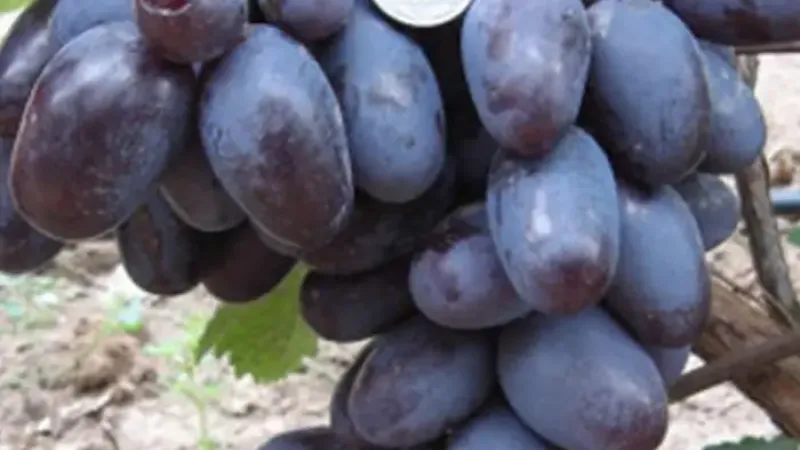
An early blue variety (a cross of 'Talisman' × 'Velika') that immediately draws attention with attractive, high-value clusters. The berries are very large (20–25 g, measuring 42 × 26 mm), elongated in shape and uniform in size. Thanks to the looser cluster, the berries do not deform one another.
The flesh is crisp and aromatic, with sugar levels reaching 19–21 °Brix-equivalent. Clusters weigh 600–900 g, and on older vines with well-developed perennial wood they can reach up to 2 kg. The firm skin protects the berries from wasps, and ripe clusters hang on the vine for a long time without loss of quality.
Pamyati Uchitelya – muscat aroma
A very early variety (a cross of 'Talisman' × 'Cardinal') with a growing season of only 105–110 days – it ripens as early as the first ten days of August. The clusters are large and heavy (800–1200 g), cylindrical-conical in shape and uniform thanks to the absence of shot berries.
The berries (10–15 g) are dark red to purple, with dense, crisp flesh and pink juice. At full ripeness a pronounced muscat note develops fully. The berries do not crack even under fluctuating moisture, which reduces the risk of rot.
Armani – elegance with tender skin
A very early red variety with a growing season of 105–115 days, ripening in the first half of August. Clusters weigh 800–1200 g and have a classic conical shape. The berries are very large (17–20 g, measuring 36 × 28 mm), oval and uniform, without any stunted berries.
The colour is red-purple, the skin tender and not at all noticeable when eating. The flesh is fleshy and juicy, with sugar levels of 18–19 °Brix-equivalent. Its good transportability makes it suitable for selling as well.
Matador – the champion of fruit size
An early blue variety (the same parents as 'Alvika': 'Talisman' × 'Velika') with extremely large berries (20–30 g, measuring 48 × 26 mm, nearly 5 cm long). The clusters have a neat cylindrical shape and weigh 800–1200 g.
The flesh is very dense, fleshy, crisp and juicy, with thin skin. A major advantage is that the berries do not crack even in rainy weather, protecting the harvest from rot just before picking.
Ivanka – seedless with large berries
An early blue seedless variety (a cross of 'Talisman' × 'Alenushka') belonging to seedlessness class II – seeds either do not form at all, or only as very soft rudiments imperceptible when eating. For a seedless variety, the berries are exceptionally large (9–10 g).
The clusters are huge and richly branched (700–1500 g). The flesh is dense, fleshy, crisp and very sweet (18–21 °Brix-equivalent). An ideal choice for children and for fresh eating.
Mont Blanc – ultra-early reliability
A modern Ukrainian variety (breeder A. V. Burdak, a cross of 'Demetra' × 'Novy Podarok Zaporozhyu') with ultra-early ripening – a growing season of only 85–100 days. Every year, regardless of the weather, it yields an abundant crop of yellow-white clusters with characteristic teardrop-shaped berries (10–14 g).
The clusters are looser (700–1200 g, up to 1800 g), which prevents rotting. The variety withstands frosts down to −23 to −26 °C and can even bear fruit from dormant buds. Ripe clusters hang on the vine until the first frosts.
Pamyati Smolnikova – nipple-shaped pink berries
A highly productive early to mid-early variety (a cross of 'Voskovoy' × 'Charrel') with huge clusters (900–1700 g) hanging on a long stalk. The berries are large (12–16 g), light pink and have a distinctive nipple-like shape. Sugar levels reach 20–22 % at balanced acidity.
The variety is practically not attacked by wasps and withstands frosts down to −24 °C. However, it requires consistent crop regulation – overloading risks exhausting the vine and reducing fruit quality.
Veldze – a Latvian rarity for the north
A unique Latvian variety from the legendary breeder Pauls Sukatnieks (a cross of 'Madeleine Angevine' × 'Dvietes Zilā'), officially registered in 2000. Its rarity lies in the fact that at full ripeness a berry can be picked so that the seeds remain attached to the stalk – leaving you with clean, seedless flesh.
The clusters are medium-sized (100–200 g), the berries round (approx. 3 g) and greenish-yellow to amber in colour. The flavour is sweet with a pronounced strawberry aroma of the Vitis labrusca species. Its strong growth makes it ideal for pergolas, but it requires regular pruning and protection against powdery and downy mildew.
A note on crop regulation. Varieties with exceptionally large clusters (especially 'Pamyati Smolnikova') have a strong tendency to overload. Without consistent thinning of the number of clusters, the vine risks exhaustion, reduced fruit quality, and weakened ripening of the wood before winter.
When choosing a variety, consider not only berry size but also ripening time and the climatic conditions of your location. Ultra-early varieties such as 'Mont Blanc' ripen reliably even in cooler regions, while large-fruited varieties reward the grower's patience given good sun exposure.
A Guide to Ripening Times
Ultra-early (85–100 days): Mont Blanc – ripens as early as late July / early August.
Very early (105–115 days): Pamyati Uchitelya, Armani – early to first half of August.
Early (115–125 days): Alvika, Matador, Ivanka, Pamyati Smolnikova, Veldze – second half of August into September.
Plant your own vineyard
You can find these large-fruited table grape varieties as quality, well-rooted plants in our online shop. Choose from ultra-early to seedless and grow market-quality clusters right in your own garden.
Visit the shop →
|
Join our community
Exchange growing experiences, ask about varieties and share your harvest in our Facebook community full of enthusiastic fruit growers, discuss with experts and be the first to access new articles.
Visit our page →
|