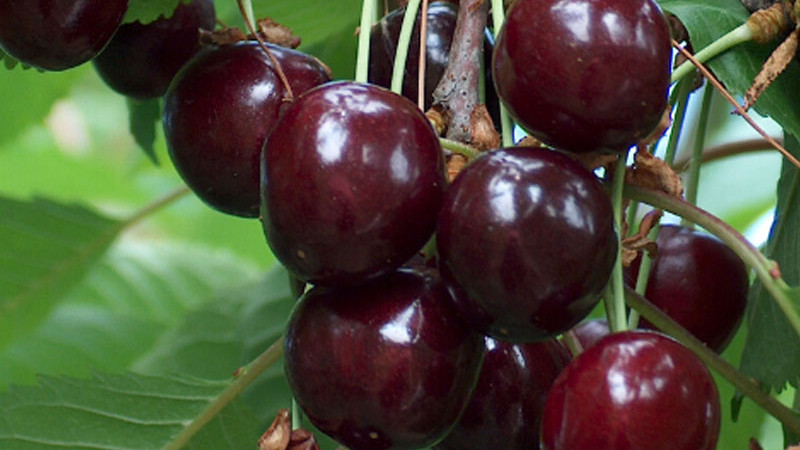
The sour cherry is one of the most rewarding fruit trees for the home garden. It needs less space than a sweet cherry, tolerates cooler sites, and most varieties reward the grower with reliable crops within just a few years. In this overview we have gathered six varieties – Russian and Belarusian – that differ in flavour, fruit size, pollination needs and hardiness. They will help you pick the right one based on what you expect from the tree.
Three of the varieties presented are self-fertile or partly self-fertile, which owners of smaller gardens will appreciate where there is no room for a second tree. The others need a suitable pollinator nearby, but in return they offer exceptional flavour or yield.
|
6
varieties compared
|
4.8
highest tasting score
|
31.5 kg
highest yield per tree
|
3rd–4th
year of first cropping
|
A quick overview of the six varieties
Before we go into detail, here is a quick comparison of the key traits. The table will help you narrow your choice by what matters most to you – flavour, yield or low pollination demands.
| Variety |
Ripening |
Flavour (of 5) |
Pollination |
Hardiness |
| Bulatnikovskaya |
mid-early |
3.9 |
self-fertile |
good (buds moderate) |
| Desertnaya Morozovoi |
very early |
4.6 |
partly self-fertile |
high |
| Milavica |
mid-early |
4.8 |
self-sterile |
high |
| Pamyati Enikeeva |
early |
4.8 |
self-fertile |
moderate |
| Prevoshodnaja Kolesnikovoi |
mid-early |
excellent |
partly self-fertile |
moderate |
| Studencheskaya |
mid-early |
very good |
self-sterile |
high |
← Swipe the table sideways →
Good to know: A self-fertile variety will set fruit even when it stands alone in the garden. Self-sterile varieties need another flowering cherry or sour cherry tree within reach (roughly 30–40 m) to act as a pollinator, otherwise the crop will be poor even on an otherwise healthy tree.
Variety cards
Bulatnikovskaya A reliable self-fertile variety for the small garden
A medium-tall tree (2.5–3.0 m) with a globe-shaped crown, a seedling of the ‘Shirpotreb chernogo’ variety, entered in the Russian State Register in 2001. The fruit is medium-sized (3.2 g on average), round-flattened and dark red, with red, moderately firm flesh and pink juice. The flavour is sweet-sour, with a tasting score of 3.9. The small stone (0.26 g) separates well from the flesh.
Its main strengths are self-fertility and a high yield of 10–12 kg per tree, with first cropping in the 3rd–4th year. The tree resists winter frost well, but the shoots and flower buds are moderately sensitive. It is resistant to shothole disease and moderately resistant to brown rot (moniliosis). Both fruit size and flavour are average – this is a typical utility, undemanding variety.
Desertnaya Morozovoi A very early variety with a sweet dessert flavour
A medium-vigour tree with a broad, spreading, globe-shaped crown, bred from treated seed of the ‘Vladimirskaya’ sour cherry and in the State Register since 1997. It fruits mainly on one-year-old wood. The fruit is large (4.6–5.0 g), round, red to dark red, with soft, fine and juicy flesh. The flavour is dessert-quality, very sweet with low acidity – a tasting score of 4.6.
It ripens very early, already in the second decade of June. It is partly self-fertile; suitable pollinators are ‘Griot Ostgeimsky’, ‘Griot Rossoshansky’, ‘Vladimirskaya’ and ‘Studencheskaya’. It stands out for high hardiness, early cropping and regular yields. Note: if pruning is neglected the branches go bare, and under poorer conditions its resistance to shothole disease drops.
Milavica The newest Belarusian top variety with exceptional flavour
One of the newest and best Belarusian varieties (in the State Register since 2021), bred by crossing ‘Griot Seridko’ and ‘Prizyv’. The tree is weak-growing but fast to develop, with a globe-shaped crown. The fruit is medium-sized (4.5 g), round, deep dark red, with fine juicy flesh and deep red juice. The flavour is pleasant, sour-sweet, with a very high tasting score of 4.8.
Yield is high – up to 31.5 kg per tree – with first cropping as early as the 3rd year. It excels in high resistance to shothole disease and brown rot, high hardiness and good transportability. It needs a sunny site and lighter, fertile soils. Its only drawback is partial self-fertility – for a full crop it needs a pollinator.
Pamyati Enikeeva Large dessert fruit on a self-fertile tree
A medium-vigour tree with a rounded-oval crown and slightly drooping branches, bred by crossing ‘Zhukovskaya’ and ‘Korinka’, in the State Register since 2001. The fruit is large (4.6–4.7 g), broadly heart-shaped, dark red, with dark red, moderately firm and juicy flesh. The flavour is dessert-quality, sweet with a pleasant acidity – a very high tasting score of 4.8. The stone is larger (0.35 g) but separates well.
It ripens early to mid-early, at the end of June, evenly. It is self-fertile, but for a higher yield a pollinator such as ‘Griot Belorussky’ is recommended. Yield is high (8–10 kg per tree) and cropping starts early. Its weaker points are moderate hardiness and moderate disease resistance.
Prevoshodnaja Kolesnikovoi A productive variety with fruit of excellent quality
A Russian variety prized for its high yield and quality fruit, a complex hybrid (‘Zhukovskaya’ × ‘Zarja Povolzhja’) × ‘Zolushka’, in the State Register since 2003/2006. The tree is medium-vigour and lower-growing (up to 2.5 m), with a globe-shaped drooping crown. The fruit is large (3.9–4.0 g), oval, dark red, with dark red, moderately firm and rather drier flesh of a sweet-sour, excellent flavour. The stone separates well.
It comes into cropping in the 4th year; yield is high (113.4 q/ha on average, 203.4 q/ha at maximum). It flowers in mid-May and ripens in the second half of July. It is partly self-fertile; suitable pollinators are ‘Zhukovskaya’ and ‘Vladimirskaya’. Both hardiness and disease resistance are moderate.
Studencheskaya A hardy variety with dark, almost black fruit
A medium-vigour tree (2.5–3 m) with an inverted-pyramidal crown, a cross of ‘Zhukovskaya’ and ‘Shirpotreb chernaya’, accepted for state trials in 1977. The fruit is medium-sized (4–5 g), round, dark maroon to almost black, with juicy dark flesh. The flavour is very good, sweet with a pleasant acidity. The small round stone separates well, and the fruit picks with a dry stem scar.
It ripens in mid-July; yield is high (15–16 kg per tree, peaking in the 7th–10th year). It excels in high hardiness including the flower buds, and good transportability. It is self-sterile – it needs a pollinator such as ‘Zhukovskaya’ or ‘Turgenevka’. It requires well-drained soil and does not tolerate a high water table.
Flavour comparison by tasting score
The tasting score is an expert assessment of flavour on a scale from 1 to 5 points. The comparison below shows how the varieties stand against one another – the higher the value, the more delicious the fruit. For two varieties (Prevoshodnaja and Studencheskaya) a precise numerical score is not available, so they are not shown in the bars here.
| Desertnaya Morozovoi |
4.6 / 5 |
← Swipe sideways → | Values are relative to the scale maximum of 5 points.
Fruit chemical composition
The content of sugars, acids and vitamin C affects not only flavour but also suitability for processing. Higher sugar with lower acidity means a sweeter dessert fruit, while higher acid content suits juices and preserves better. Values are given per 100 g of fruit; for the Milavica variety no data are available.
| Variety |
Dry matter |
Sugars |
Acids |
Vitamin C |
| Bulatnikovskaya |
17.7 % |
9.0 % |
1.6 % |
15.7 mg |
| Desertnaya Morozovoi |
– |
12.77 % |
0.90 % |
10.0 mg |
| Pamyati Enikeeva |
16.3 % |
10.0 % |
1.4 % |
13.5 mg |
| Prevoshodnaja Kolesnikovoi |
16.92 % |
11.98 % |
1.36 % |
11.0 mg |
← Swipe the table sideways →
A note on pollination: The Milavica and Studencheskaya varieties are self-sterile, and even the partly self-fertile varieties (Desertnaya Morozovoi, Prevoshodnaja Kolesnikovoi) reach a full crop only with a pollinator nearby. If you plan to plant a single tree, choose a self-fertile variety – Bulatnikovskaya or Pamyati Enikeeva.
Which variety is for you?
A short guide based on what you expect most from your tree:
|
Room for only one tree: choose the self-fertile Bulatnikovskaya or Pamyati Enikeeva. |
|
You want the tastiest fruit: go for Milavica, Pamyati Enikeeva or the very sweet Desertnaya Morozovoi. |
|
You live in a harsher, cold site: favour the hardy Milavica, Studencheskaya or Desertnaya Morozovoi. |
|
You care about high yield: the most is offered by Milavica (up to 31.5 kg) and Studencheskaya. |
The best variety is not the one with the highest score, but the one that fits your garden – your soil, your site, and whether you have room for a pollinator.
Sour cherries are rewarding trees that, with the right variety choice and regular pruning, will repay the grower for many years. Whether you are looking for an undemanding self-fertile variety for a corner of the garden, or a collection of trees with different ripening times to extend the harvest, among these six varieties everyone will find their match.
Choose your sour cherry
From sweet dessert varieties to hardy, productive trees – all six varieties from this overview can be pre-ordered in our shop as quality grafted young trees. Get your garden ready for an abundant harvest.
Visit the shop →
|
Join us
Share your growing experience, ask about varieties and show off your harvest on our Facebook page full of keen fruit growers, talk with experts and get early access to articles.
Visit the page →
|